The museum comes to life Escape Room Adventures - 3,4-Digit Addition and Subtraction
The Museum Comes to Life: two escape adventures that make 3- digit addition and subtraction fun
- The Museum Comes to Life: escape-room math that checks itself
- Twelve rooms, two links, no prep
- Six ways to ask the same question — and why that matters
The Museum Comes to Life is that review or practice day, rebuilt as an escape adventure. Every night at midnight the museum wakes up — the dinosaur wanders off, the rockets end up on the wrong launch pads, the Roman statues forget their own door code — and the only way to put it right before the guards arrive at sunrise is arithmetic.
There are two adventures:
- The addition adventure — six rooms of 3-digit addition with regrouping
- The subtraction adventure — six rooms of 3- and 4-digit subtraction, including borrowing across zeros
Each one is a single link. Nothing to print, nothing to log into, and nothing for you to mark.
How it works
- Open the link. The adventure fills the screen in any browser. There is no account, no install and no menu to explain.
- Read the room. A scroll on the right tells the story and the task — what has gone wrong in this exhibit, and what the figurines need.
- Solve the puzzle. Students work out the arithmetic on paper or in their heads, then type their answer into the boxes on screen.
- Press Submit. The museum guard appears immediately: a full-screen Correct!, or Not quite… try again with check your clues.
- Correct unlocks the room and shows the exhibit put right — the shields back on their pedestals, the tablet complete, the planes lined up.
- Finish all six and the whole museum turns out for an Escape Complete! celebration. That last screen is worth staying for, and students will tell you so.
There is no timer, no score and no leaderboard. A room either opens or it does not, and a wrong answer costs nothing but another go.
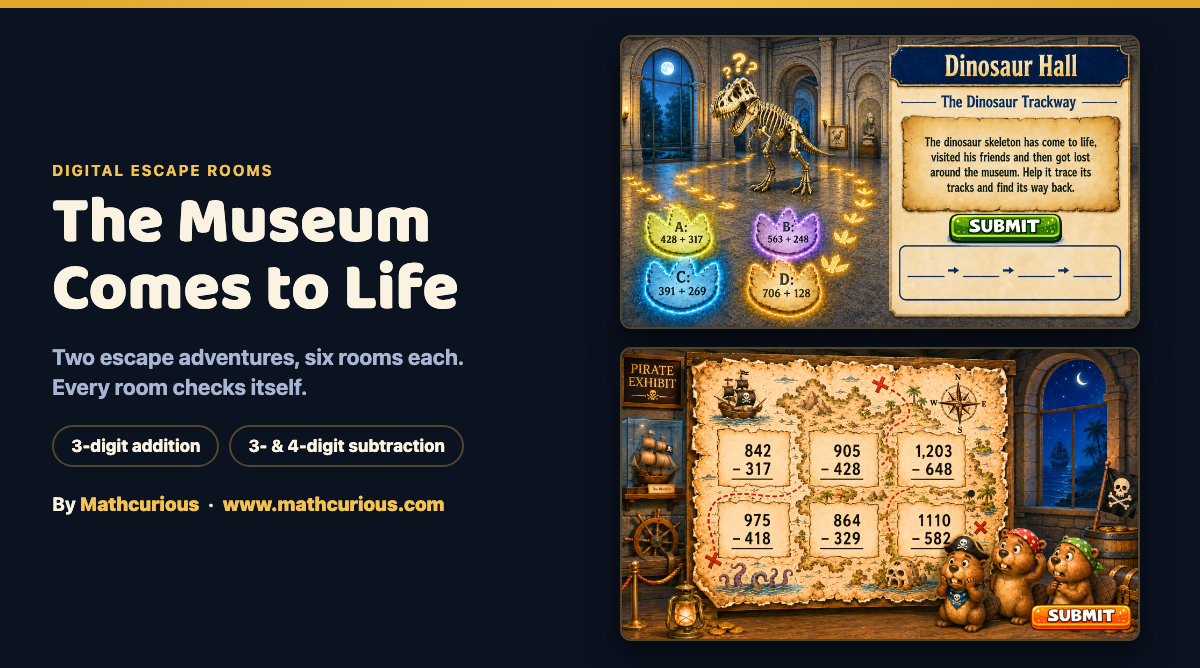
- Regrouping in the place it bites. In Dinosaur Hall all four sums regroup the ones; two of them regroup twice. 706 + 128 hides a zero in the tens, the exact spot students lose when they line digits up by eye.
- Borrowing across a zero. The Pirate Exhibit has three of them — 905 − 428, 1,110 − 582, 1,203 − 648 — which is the single most common place a subtraction falls over.
- Answers close enough to matter. The Aviation Exhibit's four differences are 816, 846, 855 and 926. You cannot estimate your way to that order; you need the real answers. The Pirate map's six answers all sit between 477 and 557, so a dropped borrow does not produce an obviously silly result — it produces a plausible wrong one, and students have to check by adding back.
- The four-digit stretch. The Art Gallery slips in 1,128 + 372 and the tunnels hold 2,537 − 1,858, so students who have only ever met three digits get one column further without a whole new activity.
Instant feedback is the whole design
Every room checks itself, and it checks itself immediately.
That matters twice over. For the student, a wrong answer is something they fix in the next thirty seconds, while they still remember what they did — which is the difference between practice and a pile of marking that comes back on Thursday. For you, it means a room full of students who are all getting feedback at once, none of it from you, so you can sit down with the four who need you and stay there.
"Not quite… try again" also does something a red cross does not: it sends them back to the clues. The guard does not say which sum was wrong. Students have to re-check their own work to find it, which is exactly the habit you want.
How to use it
Whole class, on the board. Project room one and solve it together — reading the scroll aloud, taking suggestions, arguing about the answer before anyone presses Submit. Then send the link and let them go.
Math centers and rotations. One link, no instructions past the first room, and it survives being a station.
Partners, with roles. One student reads the clue and keeps the paper; the other drives. Swap every room. The reader is doing as much maths as the driver, and they have to agree before Submit.
Early finishers. Six rooms is a genuine twenty to forty minutes, so it is not a two-minute filler that runs out.
Intervention and small groups. Sit with three students and watch which room they stall in. Stalling on the Art Gallery is a computation problem; stalling on the Ocean Exhibit is a reasoning one. The rooms diagnose for you.
Sub plans. No login, no accounts, nothing to print, and the activity marks itself. Leave the link and a note.
The last week before a break. This is the one it was built for. It feels like a treat and it is a full unit review.
Two adventures, two groups. Put the group who still needs addition on the first link and the group ready for subtraction on the second, in the same lesson, in the same room. Same story, same characters, different maths.
Seven teaching moves
1. Make them say it before they type it. Nothing goes into a box until somebody can explain why. The escape frame makes this easy to enforce — guessing costs a "Not quite," and students learn that fast.
2. Use the wrong answer. When the guard says check your clues, do not give the answer. Ask: which one would you re-do first, and why? Choosing where to look again is a skill, and it is the one a worksheet never asks for.
3. Ones digits first. In the Space Gallery and Ancient Egypt, the pairs that work are the ones whose ones digits make 10 (3 + 7, 8 + 2, 4 + 6). Let students discover that shortcut, then make them verify the whole sum. Strategy and check, in one room.
4. Estimate before computing. In the Art Gallery, 746 + 689 is roughly 750 + 700 = 1450 — already short of 1500. Ask for an estimate on all four before anyone adds properly, then see how much work the estimate saved.
5. Parity without arithmetic. The Gold Rush tunnels have twenty stones and one rule: don't step on uneven stones. ("Uneven" is the old word for odd — say so if nobody bites.) Students can sort all twenty by parity alone — even − even and odd − odd are always even, a mixed pair is always odd — without finishing a single subtraction. Then have them check a few. It is the best twenty minutes in either adventure.
6. Run the algorithm backwards. Ancient Rome (3A8 + B6C = 914) and the Medieval Hall door (9□2 − □6□ = 475) both ask students to work right to left recovering digits, carries and borrows included. Anyone who can do this understands why the carry goes where it goes, not just that it does.
7. Improve, don't restart. The Ocean Exhibit has no recipe. Tell students to put something in, look at what it made, and make it better. Watching a class realise that spending the 9s and 8s on the biggest sum is exactly what leaves 0–5 for the smallest one is the best moment in the addition adventure
What it does for you
- No prep. Open the link and teach. Nothing to print, cut, laminate or mark.
- No login, no accounts, no app. Nothing for students to sign up to, which is what makes it work for homework and cover lessons.
- It marks itself. Instant feedback in every room, so you are free.
- It holds the room. The story carries students who have already decided how they feel about arithmetic worksheets.
- One link for the whole class. Same activity on every device, every desk.
- It is review that is not a review sheet. Same content, completely different afternoon.
- It ends properly. The Escape Complete! screen gives the work a finish line, which a worksheet never has.
Devices and practicalities
Both adventures run in a browser — Chromebook, laptop, iPad, or an interactive whiteboard for whole-class work. The art is full-screen and illustrated, so it reads from the back of the room.
A few things worth knowing before you set it:
- Students type their answers, so a tablet will want its on-screen keyboard, and a keyboard-first device is the smoother experience.
- Have paper out. The rooms deliberately do not do the arithmetic for you. Working on paper next to the screen is the point, not a workaround.
- Six rooms is roughly 20–40 minutes, depending on how much you talk between them.
- There is no save. It is designed to be done in one sitting, which makes it a good fit for a lesson and a poor fit for homework split over a week
Find the Escape Adventures on TPT
The museum comes to life Addition